
The first job is deliberately modest
NASA’s Fly Foundational Robots mission plans to operate a robotic arm in low Earth orbit. One task is to pick up and reposition a modular component. The agency lists a late-2027 launch; this is an upcoming demonstration, not a repair already performed. [1]
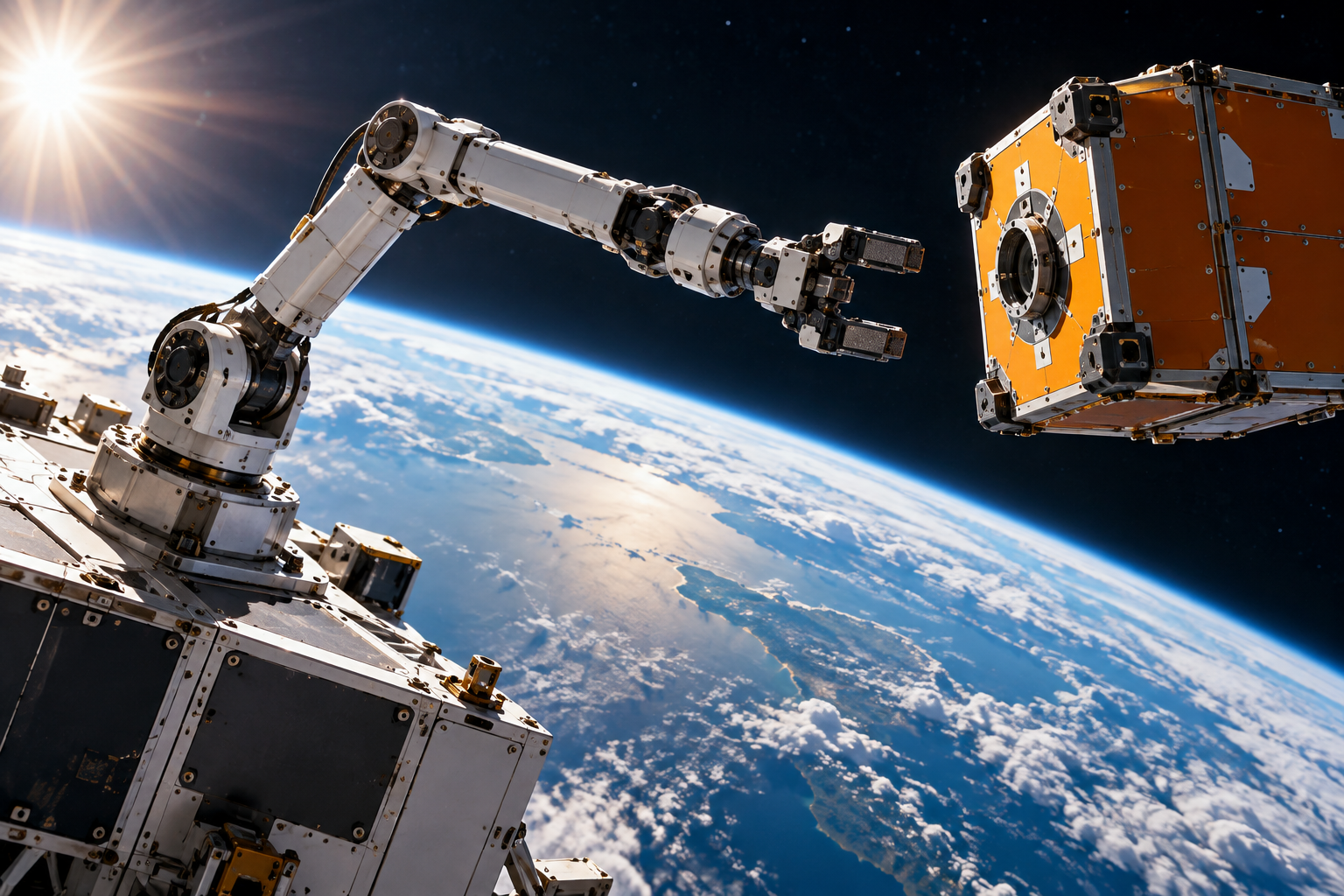
The box has a second job
Inside that movable module, the A-STEP payload is intended to test AstroPix gamma-ray sensors. NASA says it will gather data after the arm repositions the unit. The flight would therefore exercise robotic handling and provide an orbital opportunity for another technology. [2]
Why move a module?
NASA describes replacing modular components as a building block for future upgrades and servicing. The test platform is also intended to support further robotic tasks. Those ambitions explain the experiment; they do not establish that arbitrary satellites can already be repaired. [1]
What a reader should watch for
Our follow-up questions are concrete: did the mission launch, did the arm complete its assigned moves, and did the payload operate afterward? Each answer would tell us something different. A dramatic animation alone cannot answer them.
Go a little deeper
Optional reading · about 1 more minute
Why take sensors along?
NASA’s June account says the AstroPix team needs to test performance before future science missions. Comparable technology has used balloon opportunities, but those do not provide the same orbital setting. A payload designed to collect data gives the moving box a useful scientific purpose. [2]
Try the distinction
Imagine a workshop arm moving an empty toolbox successfully. Now imagine the tools inside must work after the move. In this analogy, handling the container and checking its contents are separate tests. That is a way to think about the mission, not a description of its exact acceptance criteria.
Original sources
Attributed synthesis, not original reporting. Examples labeled hypothetical or illustrative are explanatory. Reviewing a source does not independently validate its findings.
- NASA: Fly Foundational Robots ↗
Mission overview read September 12, 2026. Future technology demonstration; launch listed as late 2027.
- NASA: Robotic Tech Demo Will Advance Prototype Gamma-Ray Detectors ↗
Published June 11, updated June 12, 2026. Mission/payload description read; future operations are plans, not outcomes.