
Make room to make progress
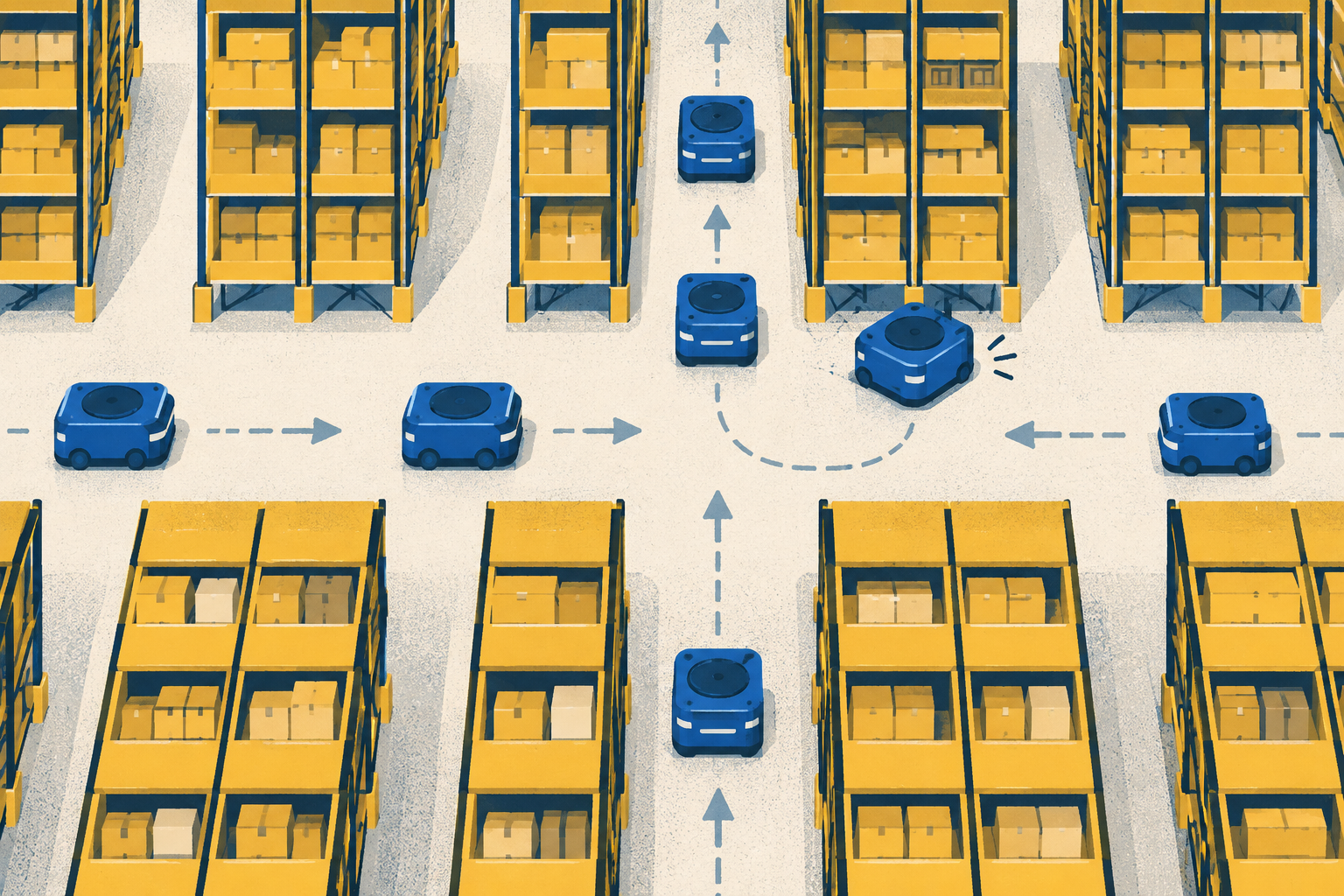
In warehouse simulations, researchers found that moving a robot temporarily away from its goal could clear an aisle for a blocked robot. The useful achievement was coordinated progress across the fleet. Their March 2026 paper combines learned priority choices with a conventional route planner. [1]
Two jobs, two kinds of software
The learning system chooses which robots receive priority. A planning algorithm then works out their movements. MIT describes training through trial and error in simulated warehouses, rewarding decisions that improve throughput while avoiding conflicts. This division keeps the learning problem focused on coordination. [2]
Imagine a narrow doorway
Hypothetical example: Two delivery carts meet near an aisle exit. The cart closest to its destination has room to back up; the one behind it does not. Giving the trapped cart a turn may help both finish. This teaching example illustrates a coordination choice, not a tested route or a rule that backing up is always best.
Where the result stops
The experiments used warehouse simulations, including a Symbotic-inspired layout that did not use exact real-world dimensions. The paper also says its location representation does not transfer without further training to maps of different sizes. These are research results, not proof that the method is ready for every warehouse. [1]
Go a little deeper
Optional reading · about 1 more minute
Why the work is still useful
MIT’s report says the system remains far from real-world deployment. It identifies jointly choosing tasks and routes, and scaling to thousands of robots, as further work. The contribution is a tested simulation approach to deciding who should move first—not a claim about faster delivery times for customers. [2]
Ask about the whole queue
Our interpretation: When judging a robot demonstration, ask whether success means one impressive movement or more completed work across the system. For this story, the useful next evidence would be performance under real delays and operational constraints. We make no prediction about when a commercial deployment will follow.
Original sources
Attributed synthesis, not original reporting. Examples labeled hypothetical or illustrative are explanatory. Reviewing a source does not independently validate its findings.
- Zheng and colleagues: Learning-guided Prioritized Planning for Lifelong Multi-Agent Path Finding in Warehouse Automation ↗
March 25, 2026 author manuscript of the JAIR paper. Abstract, introduction, simulation setup, congestion case study and conclusion reviewed September 16; experiments not reproduced.
- MIT News: AI system learns to keep warehouse robot traffic running smoothly ↗
March 26, 2026 institutional report read September 16. Research includes Symbotic authors and support; this account is not independent replication.