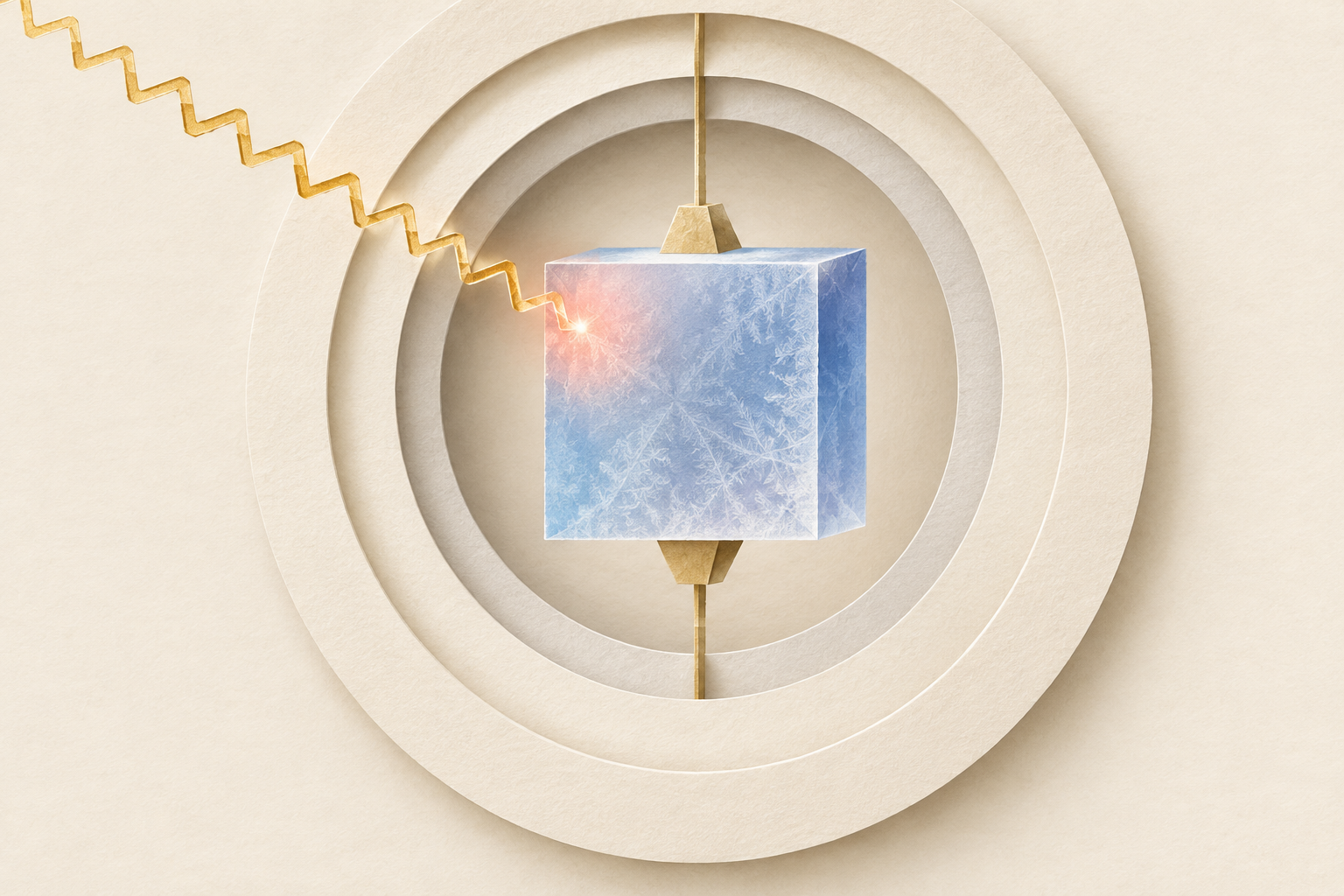
A small height, a real comparison
Yes. In February 2022, JILA researchers reported a change in clock frequency across a millimeter-scale cloud of ultracold strontium atoms, consistent with gravitational redshift. General relativity predicts that clocks at different gravitational potentials run at different rates when compared. [1]
- Upper region: faster relative rate
- Lower region: slower relative rate
- Measure the frequency difference
Compare regions inside one cloud
NIST’s account explains that the researchers compared the upper and lower regions of one trapped atom sample. Their imaging method mapped frequency across it. Near Earth, the lower clock rate is slower. This was a comparison within laboratory apparatus, not two ordinary watches placed a millimeter apart. [2]
A measurement, not a theory of everything
The original abstract describes a result consistent with gravitational redshift and the need to account for gravity within exceptionally precise atomic samples. It points toward further study of quantum mechanics and gravity; it does not report that those theories have been unified. [1]
Go a little deeper
Optional reading · about 1 more minute
Read a clock difference carefully
Hypothetical example: Imagine a diagram with two labeled regions of the same atom cloud. Before comparing their rates, ask what differs between the regions, what is held common and which apparatus effects could imitate the signal. The drawing helps organize the question; it is not a scale drawing or a measurement.
Why precision changes the experiment
Our interpretation: A feature that once seemed negligible can become part of the measurement as instruments improve. Here the interesting shift in perspective is to treat the sample’s height as part of the experiment, rather than assuming the entire sample supplies one indistinguishable reference.
Original sources
Attributed synthesis, not original reporting. Examples labeled hypothetical or illustrative are explanatory. Reviewing a source does not independently validate its findings.
- Bothwell and colleagues: millimeter-scale gravitational redshift ↗
Published February 16, 2022; issue February 17. Original abstract read in Chrome September 21. Full article is subscription content; no paywall bypass or new record claim.
- NIST: JILA clocks measure relativity ↗
February 16, 2022 report, updated February 3, 2025. Full report reviewed September 21, 2026; same-team account.