
Move the shape you want to control
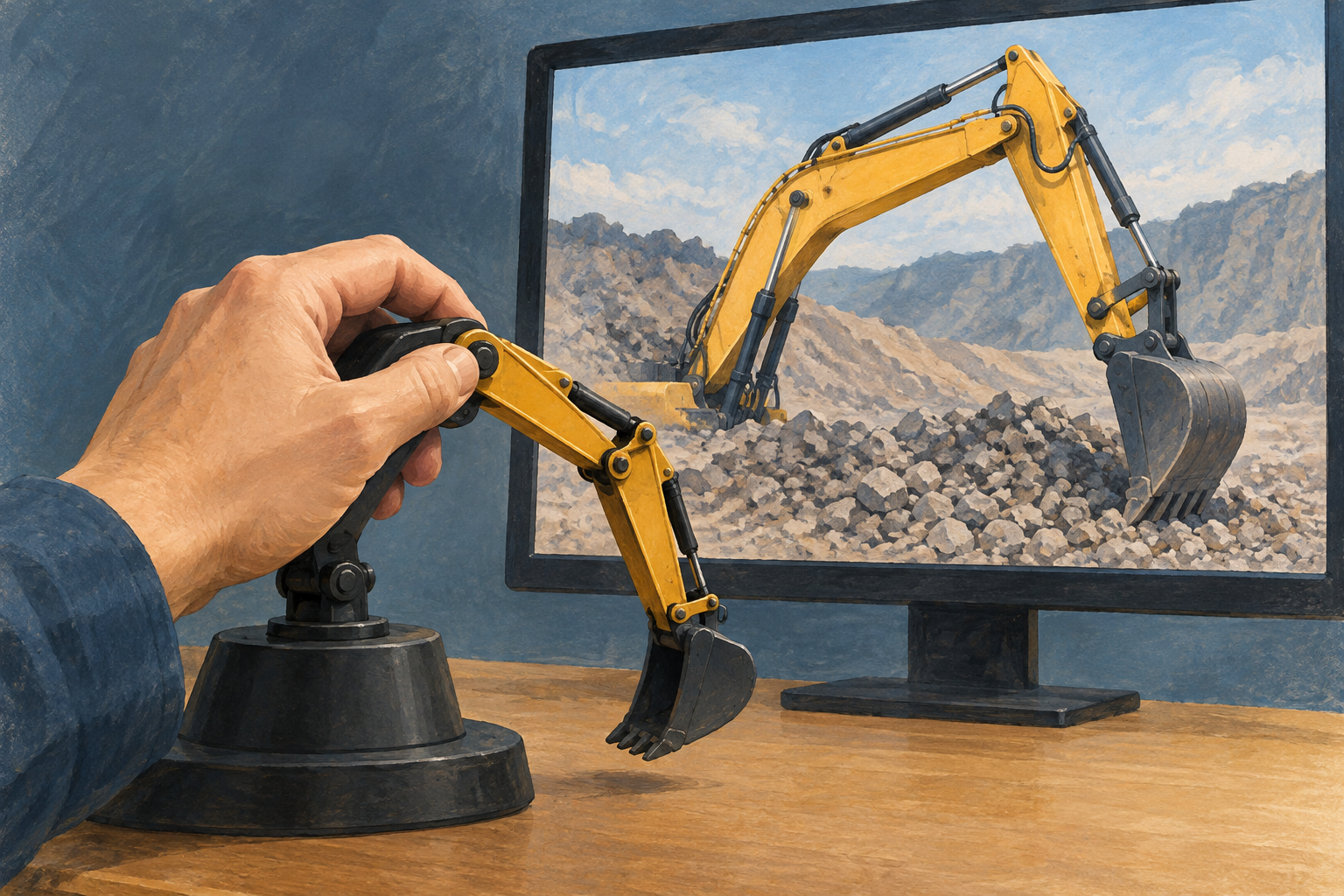
The idea is to make the controller resemble the machine’s movement. MIT’s August 20 report describes a small articulated arm that a person moves to control a virtual excavator. The operator guides the motion; this is a human-controlled interface, not an autonomous digging system. [1]
Change the translation
With conventional joysticks, an operator must coordinate separate joints to move the bucket to a desired place. The study’s World-Space Interface instead uses a scaled linkage resembling the excavator. In its simulator comparisons, novices completed cycles faster on first use with that interface than with joysticks. These are task-specific training results. [2]
The field test is still missing
The paper explicitly says that quantitative validation against an actual excavator had not been conducted and that transfer to real field tasks remained unresolved. Operators also identified problems with depth perception, contact feedback and simulated soil. A promising control mapping is not proof of job-site readiness. [2]
Go a little deeper
Optional reading · about 1 more minute
Try the distinction in your imagination
Hypothetical example: You want a bucket to move around a marked corner. One controller asks you to coordinate joint motions; another lets you guide a smaller matching arm. Now add a buried obstacle and limited visibility. The easier gesture does not itself answer how safely the whole task can be completed.
What to look for next
Our interpretation: Look for measured transfer to real equipment, realistic contact feedback and evaluations across tasks and operators. Keep the useful interface idea separate from claims that a beginner can immediately do an expert’s job.
Original sources
Attributed synthesis, not original reporting. Examples labeled hypothetical or illustrative are explanatory. Reviewing a source does not independently validate its findings.
- MIT: an excavator-shaped training controller ↗
August 20, 2026 institutional report; interface description and proposed uses read September 20. Same research team, not independent replication.
- Ishida and colleagues: excavator training platform ↗
Published online August 17, 2026; November issue label is not the online date. Open-access abstract, introduction, discussion and limitations read in Chrome September 20; no field-transfer result established.