
Use a partner as a reference
How do you test a light detector when the light is too faint to measure easily? NIST describes a method using correlated photon pairs, with one photon headed toward each of two detectors. A detection on one side acts as a trigger indicating that a partner photon is headed toward the other. [1]
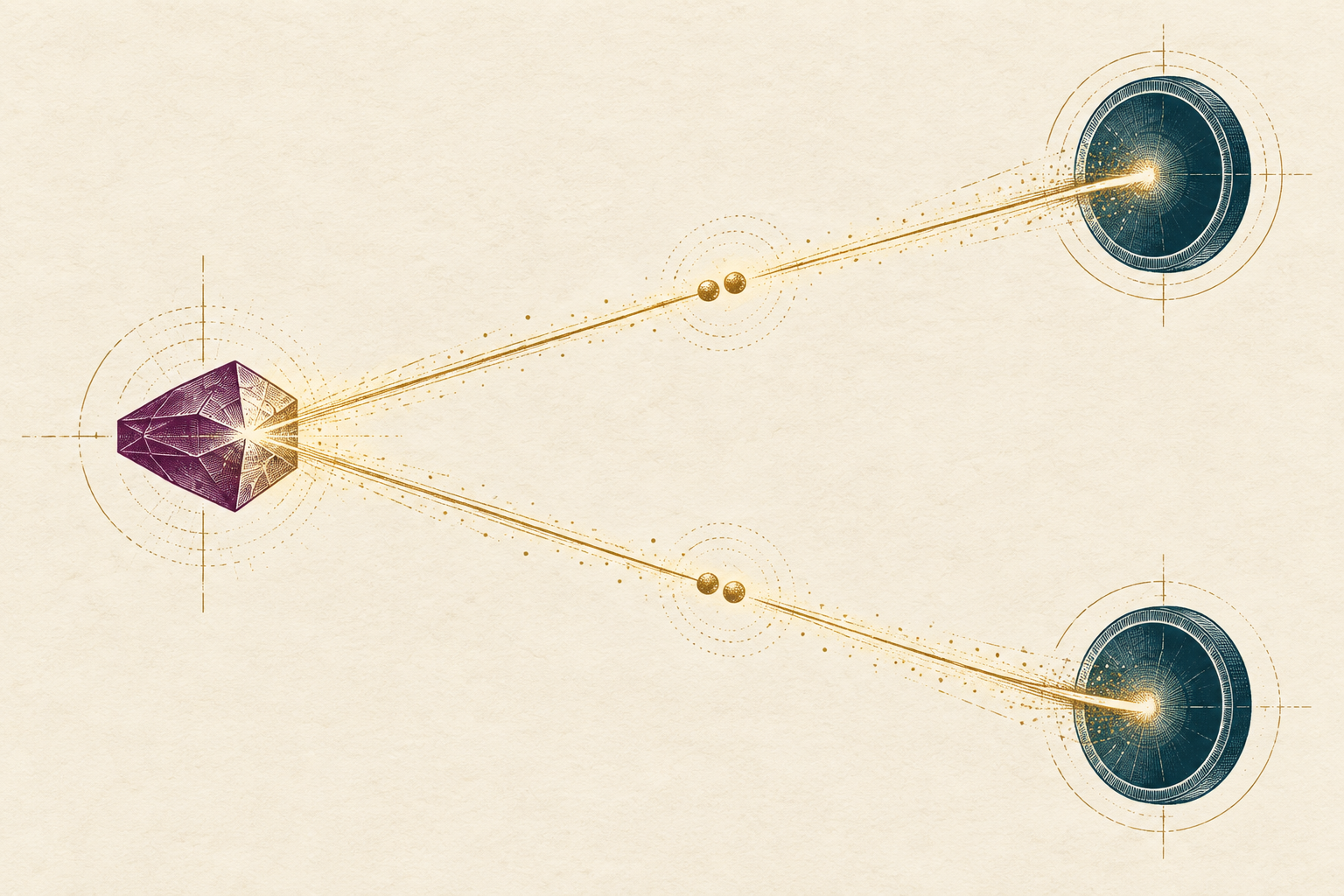
Compare single and paired detections
Record the trigger counts and the events detected together, called coincidences. In the idealized relationship NIST describes, coincidences divided by trigger counts give the other detector’s efficiency. The unknown photon-pair production rate cancels from the ratio. [1]
Try an invented count
Hypothetical example: In an ideal, loss-free setup with no background events, imagine 100 valid triggers and 80 matching detections. The ratio is 80/100, or 80%. Those are invented numbers to explain the calculation, not a measured detector specification or a complete laboratory calibration.
Go a little deeper
Optional reading · about 1 more minute
Efficiency is only one property
NIST’s broader detector overview explains that calibration also needs to characterize recovery time, noise and afterpulsing. A detector goes through internal processes before producing a signal and then must reset. One efficiency number cannot describe all of that behavior. [2]
An established method, not today’s announcement
The correlated-photon page is explicitly marked as no longer maintained. We use its basic counting explanation as historical background, not its experimental goals as current news. The second overview cites a 2007 calibration study; this article makes no new accuracy-record claim. [1] [2]
Original sources
Attributed synthesis, not original reporting. Examples labeled hypothetical or illustrative are explanatory. Reviewing a source does not independently validate its findings.
- NIST: Correlated photon radiometry ↗
Historical institutional explanation; page created 2009, updated May 27, 2026 but marked no longer maintained. Basic counting mechanism read October 6.
- NIST: Sources, detectors and metrology ↗
Institutional overview; detector characterization and reset processes read October 6, 2026. Cited 2007 result treated as historical; no record claim.