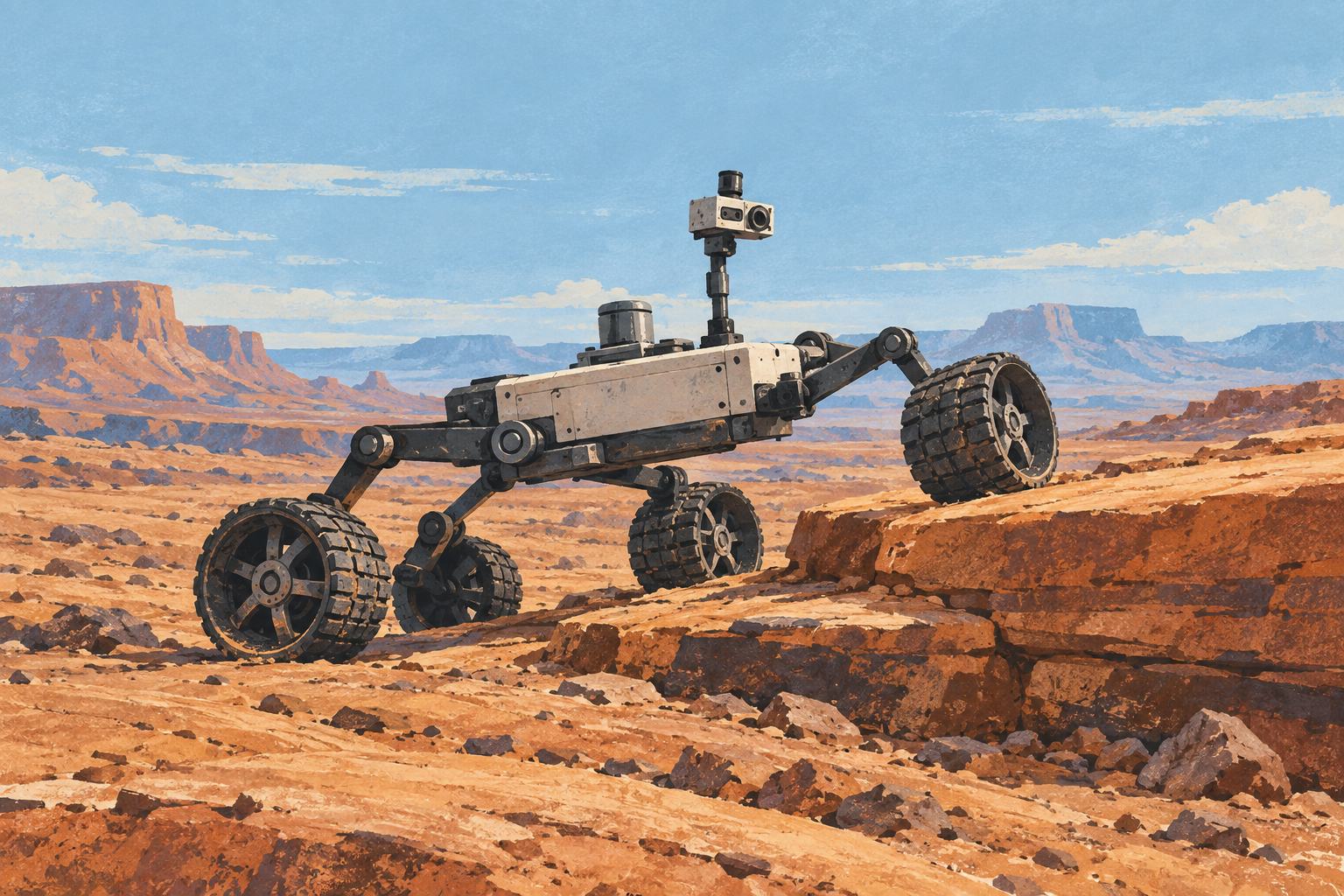
The wheels affect one another
JPL’s June 2017 report explains how wheels climbing uneven terrain can be pushed or pulled into pointed rocks by the other wheels. Curiosity’s traction-control software uses suspension changes to estimate wheel contact geometry and adjust individual wheel speeds. The aim is to reduce damaging forces and slipping. [1]
- During a drive: adjust wheel speeds
- Between drives: inspect wheel condition
- Operations: revisit driving guidance
A photograph answers another question
A NASA record for a March 2022 wheel-assessment preprint describes periodic wheel imaging and how assessments influenced driving guidance and imaging frequency. Its damage snapshot is explicitly from August 2021. This explainer reviewed the repository abstract; the linked full paper was unavailable. [2]
Two kinds of feedback
Our interpretation: Wheel-speed control responds during movement. Periodic inspection helps people assess how damage accumulates and reconsider operations. Neither observation substitutes for the other: good motion control does not itself establish the long-term condition of a wheel.
Go a little deeper
Optional reading · about 1 more minute
Software cannot erase a puncture
JPL’s historical account describes adjusting other wheel speeds when a climbing wheel lifts away from the surface. Its reported tests concern reducing loads, not repairing existing metal damage. We do not extend those test results into an estimate of today’s remaining wheel life. [1]
An engineering history, not today’s condition report
Our interpretation: The transferable lesson is to connect a condition check to a decision. Before reusing an old inspection result, ask when it was taken and what changed afterward. The sources here explain historical methods, not the rover’s current damage count.
Original sources
Attributed synthesis, not original reporting. Examples labeled hypothetical or illustrative are explanatory. Reviewing a source does not independently validate its findings.
- JPL: an algorithm helps protect Curiosity’s wheels ↗
June 29, 2017 official engineering report, force mechanism and traction-control paragraphs read September 29. No current-state or remaining-life claim.
- NASA NTRS: assessing Curiosity wheel damage ↗
March 5, 2022 preprint record; abstract describes August 2, 2021 state. Abstract reviewed September 29; external handle and PDF unavailable, no detailed methods claim.