
Radio becomes an optical measurement
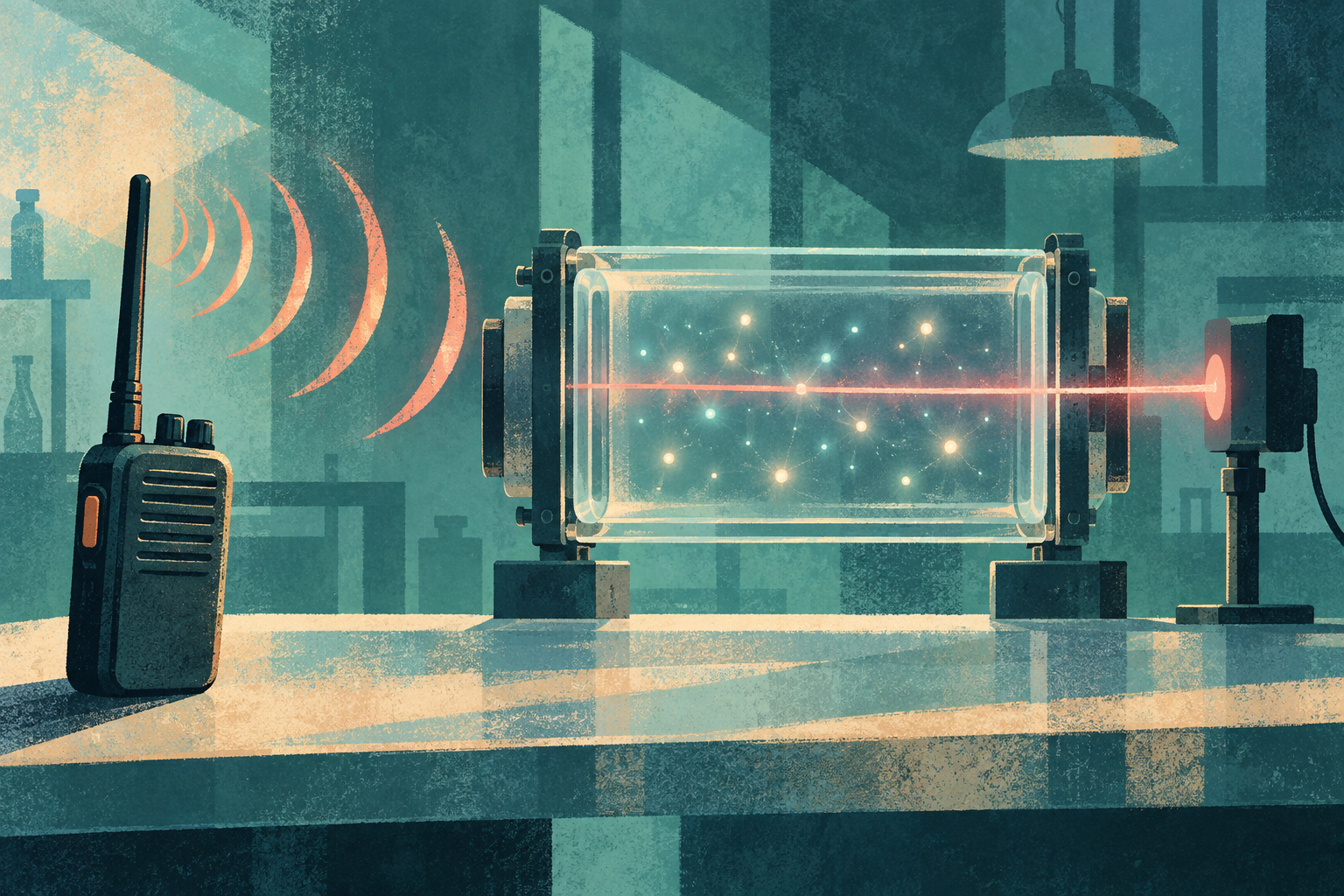
Highly excited atoms can respond to an electric field. In a February 2026 paper, NIST researchers used that response to recover speech from an ordinary handheld radio. The experiment connects a familiar transmitter to an unusual receiver: a vapor of rubidium atoms probed with laser light. [1] [2]
The missing step is a reference signal
The radio carries speech in changes of frequency. The team adds a nearby reference tone, called a local oscillator. Together, the fields produce a changing beat signal that affects light passing through the atoms. A photodetector and lock-in amplifier convert the measured signal into audio. [2]
A demonstration with equipment attached
The paper reports reception of two neighboring radio channels at once. It also describes modest demonstrated range and identifies the required local oscillator as a drawback. This is laboratory reception, not evidence that a pocket-sized atomic radio has replaced a conventional receiver. [2]
Go a little deeper
Optional reading · about 1 more minute
Follow the information
Our interpretation: The striking part is the chain of conversions: radio field, atomic response, light, electrical signal, sound. Calling it a quantum sensor describes one part of that chain; it does not make the other equipment disappear.
What was actually checked
The primary paper’s measurement scheme and conclusion support this mechanism. We have not replicated the apparatus or independently measured its performance. No claim of superior consumer range, cost or battery life is made. [2]
Original sources
Attributed synthesis, not original reporting. Examples labeled hypothetical or illustrative are explanatory. Reviewing a source does not independently validate its findings.
- NIST: atomic reception of a handheld radio ↗
Published February 10, 2026; publication abstract and date checked September 23, 2026. Institutional account, not independent replication.
- Schlossberger and colleagues: Physical Review Applied paper ↗
Published February 10, 2026; measurement scheme, multi-channel discussion and conclusion read September 23, 2026. No apparatus replication.