
Reshape the uncertainty
Squeezing does not physically squash a beam. It prepares a quantum state with less uncertainty in one property and more in its paired property. For light, that trade can involve phase—where a wave is in its cycle—and amplitude. LIGO, the Laser Interferometer Gravitational-Wave Observatory, uses light to measure the tiny changes caused by gravitational waves. [1]
Why one kind of quiet was not enough
LIGO’s October 2023 account describes a limitation of its earlier squeezing: better high-frequency sensitivity came with worse low-frequency sensitivity. Light’s fluctuating pressure can move the detector mirrors, adding a different source of noise. The useful question is therefore which fluctuations limit the measurement at each frequency. [2]
Let the frequency set the trade
A paper published October 30, 2023 reported frequency-dependent squeezing in the full-scale LIGO detectors. Added optical filter cavities rotate the squeezed state differently at different frequencies, reducing both shot noise in the readout and quantum radiation-pressure noise. This is an established detector result, not a new September 2026 discovery or a claim that all noise has vanished. [3]
Go a little deeper
Optional reading · about 1 more minute
A conceptual picture
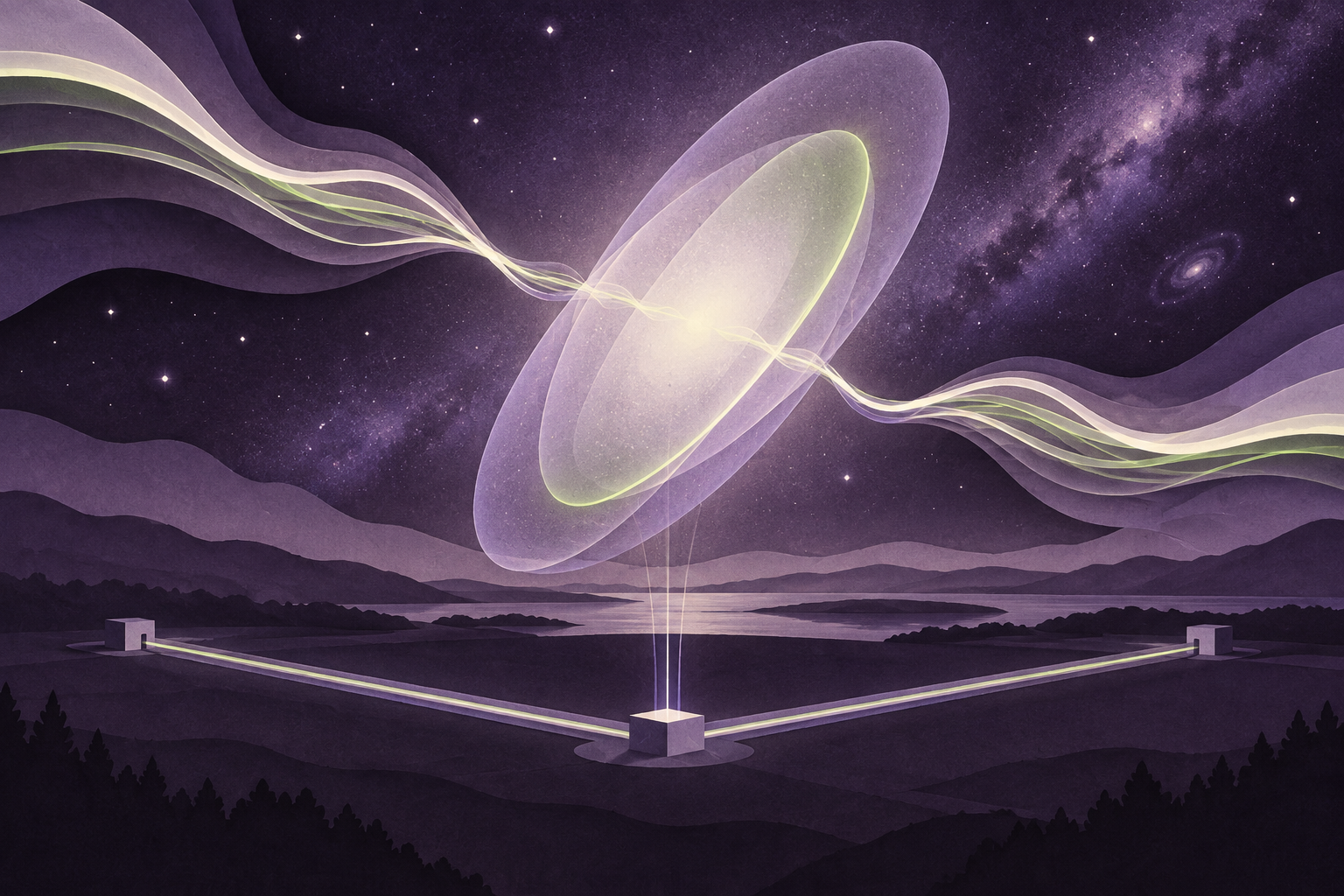
Analogy: Imagine an uncertainty patch becoming narrower in one direction and wider in another. Turning that patch changes which direction is narrow. This picture is a guide to the trade, not a drawing of photons being compressed or a measured LIGO noise plot.
Read the improvement in context
Our interpretation: Ask which noise source, which frequency range and which comparison the improvement refers to. A detector can gain useful sensitivity without escaping quantum mechanics. The achievement is engineering the measurement around the trade rather than pretending the trade is gone.
Original sources
Attributed synthesis, not original reporting. Examples labeled hypothetical or illustrative are explanatory. Reviewing a source does not independently validate its findings.
- NIST: squeezed light and gravitational waves ↗
Created January 12, 2026; updated April 1. Mechanism explanation reviewed September 22, 2026.
- LIGO: the frequency-dependent squeezing upgrade ↗
October 23, 2023 institutional account read in Chrome September 22; same collaboration, not independent replication.
- Ganapathy and colleagues: broadband quantum enhancement ↗
Physical Review X, October 30, 2023. Original abstract and Popular Summary read September 22; no current event-rate claim.