Looking from inside the skin
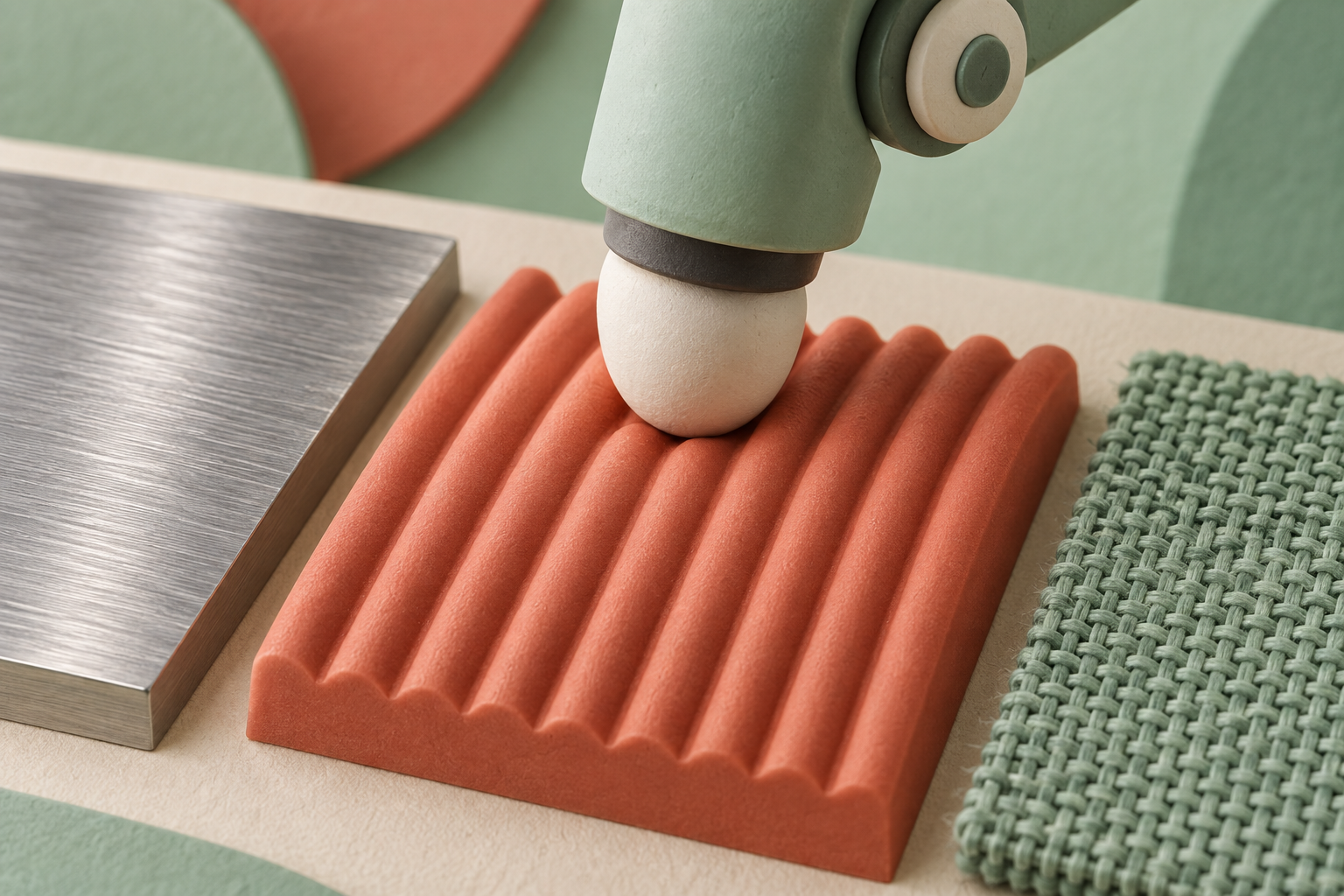
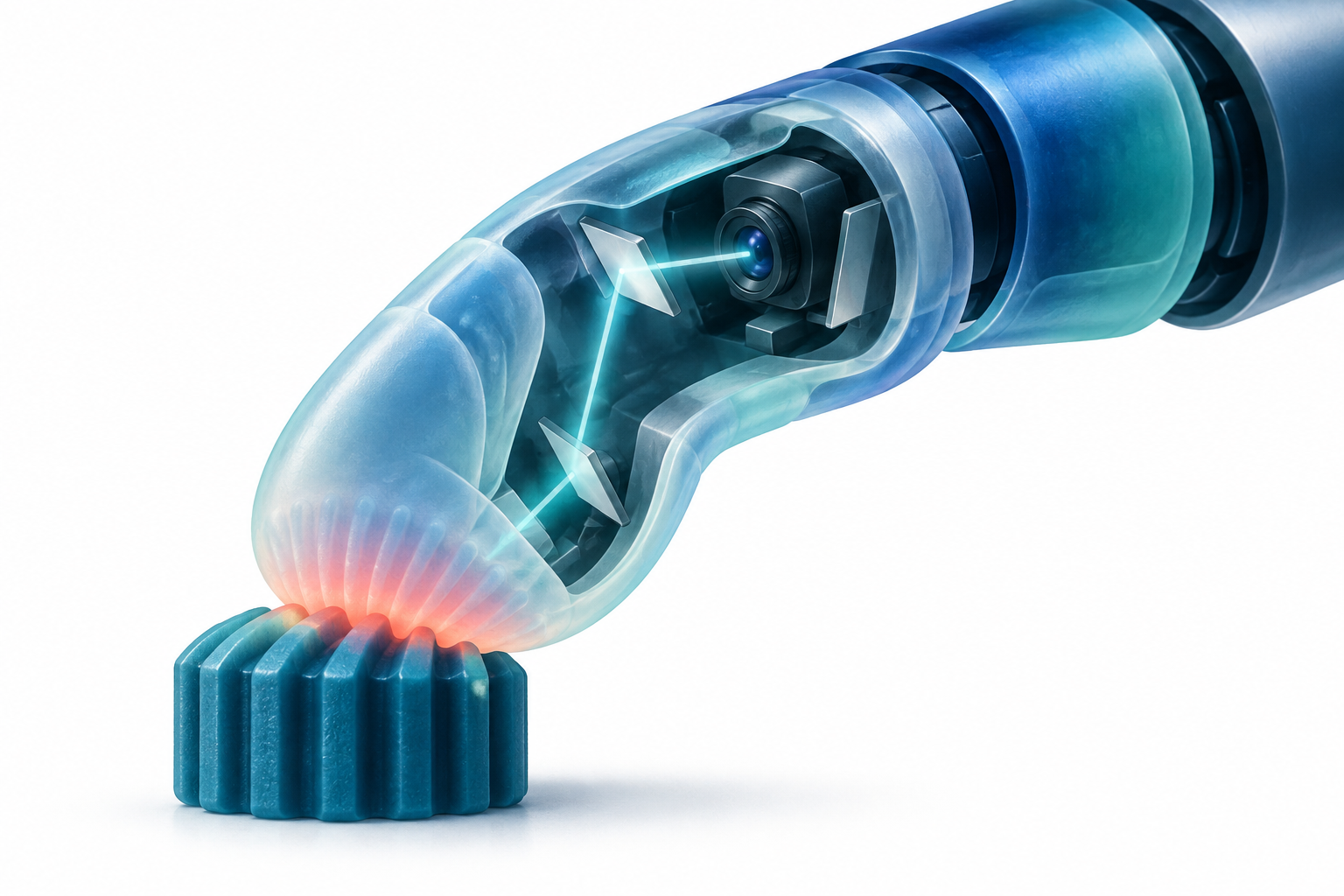
In MIT’s October 2023 account of GelSight Svelte, an internal camera observes a soft skin as contact changes its shape. Two mirrors extend the camera’s view along a curved finger. The useful idea is that touch becomes something a camera can measure, over more than a small fingertip. [1]
Folding a view into a narrow space
Zhao and Adelson’s September 2023 paper describes one flat mirror and one curved mirror, with a camera housed inside the finger. The folded optical path addresses a packaging problem: extending the sensing surface without putting a bulky camera outside it. A flexible backbone also bends and twists; tracking its deformation supports estimates of the torques acting on the finger. [2]
Sensing is one part of grasping
The paper reports object-holding demonstrations with three fingers, including a small brick, screwdriver and flashlight. Those grasp tasks were open loop: the demonstration did not use tactile feedback to continually adjust the grasp. The result therefore supports a sensor design and its measurements, rather than a claim that a robot can autonomously handle arbitrary objects. [2]
Go a little deeper
Optional reading · about 1 more minute
Two questions inside one grasp
Hypothetical example: Imagine holding a ridged tool. A contact image could help describe where its ridges press, while a bending estimate could describe loading on the finger. Those are different questions. Deciding how the hand should move next would require a controller that uses the information.
What to look for in a follow-up
Our interpretation: A persuasive next demonstration would show the hand responding to changing contact, with clear failure cases and repeated trials. Broader sensing coverage creates an opportunity for control; it does not by itself establish reliable manipulation.
Original sources
Attributed synthesis, not original reporting. Examples labeled hypothetical or illustrative are explanatory. Reviewing a source does not independently validate its findings.
- MIT: finger-shaped sensor enables more dexterous robots ↗
October 4, 2023 institutional report; Mirror mirror mechanism read September 28. Historical research, not a current product announcement.
- Zhao and Adelson: GelSight Svelte ↗
September 19, 2023 v1 paper; sections II–IV, optical design and open-loop object holding read September 28. No quantitative performance or universal grasp claim adopted.