A change in the controller
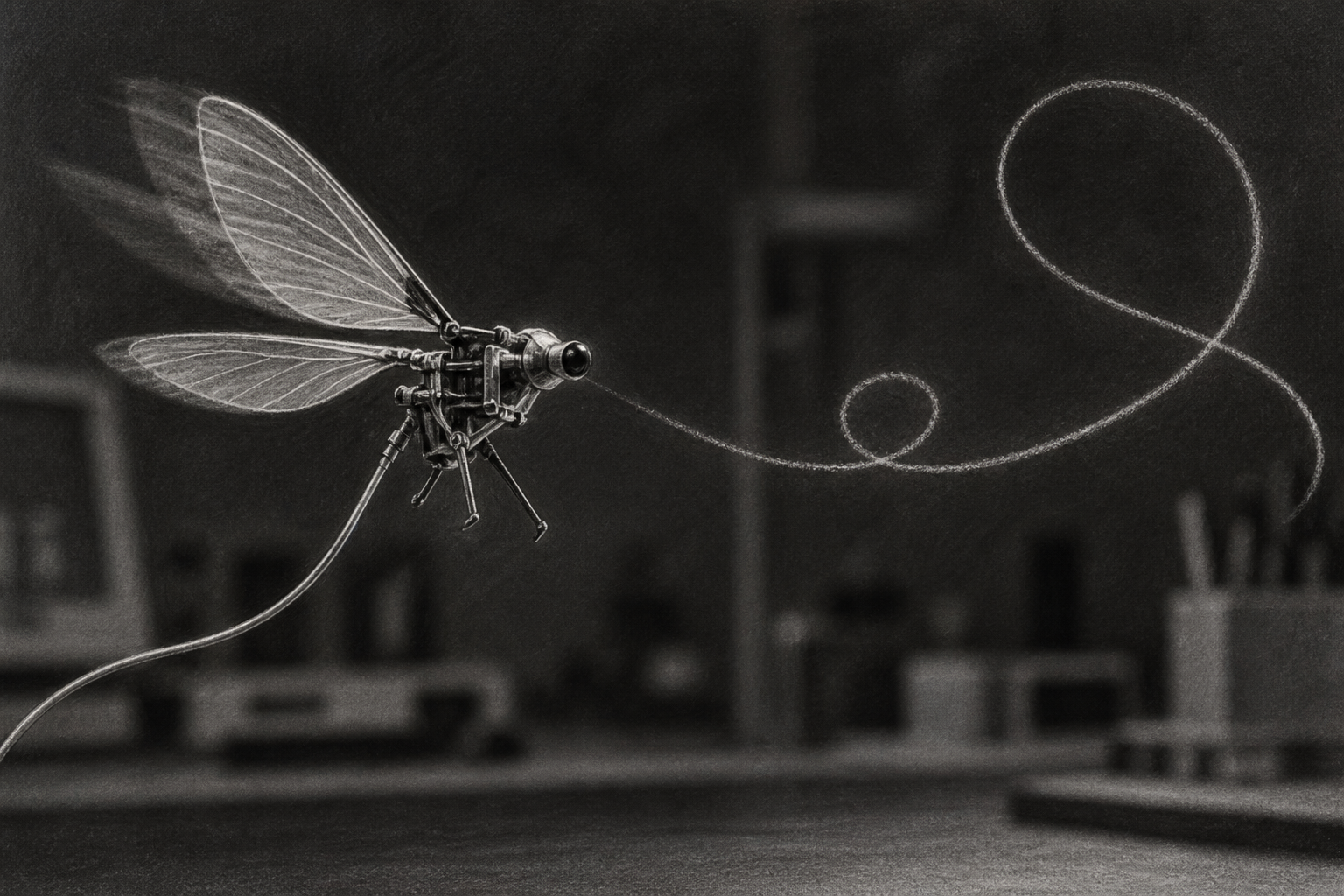
MIT reported in December 2025 that an insect-scale flying robot could perform rapid turns and repeated flips using a new control system. The interesting advance is how movement decisions are made, not a claim that miniature rescue robots are already working in disaster zones. [1]
Learn from a slower expert
The team used a mathematical planner to work out demanding maneuvers, then trained a faster AI policy to imitate it. A policy maps information about the robot’s position to movement commands. This separates expensive planning for training from quick decisions during flight. [1]
The lab is part of the machine
The reported setup uses external computing, motion capture and a power tether. MIT identifies onboard sensing and outdoor flight as future work. These dependencies belong in the explanation: a successful laboratory maneuver does not demonstrate a self-contained robot navigating an unfamiliar building. [1]
Why this is worth watching
Our interpretation: the compelling question is how much of the surrounding laboratory can eventually travel with the robot. Ask about power, sensing and computing separately. Progress on one can be valuable even while the complete machine remains an unfinished research problem.
Go a little deeper
Optional reading · about 1 more minute
A useful way to read a demonstration
A thought experiment: two robots trace the same elegant turn. One receives its position from room-mounted cameras; the other must estimate it onboard. The visible path alone does not reveal this difference. That is why the setup, not only a highlight video, deserves your attention.
Watch the next test, not just the next flip
Our suggested reading checklist: which equipment stays outside the robot, which conditions were tested, and what happens when the task changes? These are editorial questions for a future report, not claims that the researchers omitted testing. We reviewed MIT’s research account; the linked journal page was unavailable in this session.
Original sources
Attributed synthesis, not original reporting. Examples labeled hypothetical or illustrative are explanatory. Reviewing a source does not independently validate its findings.
- MIT: Aerial microrobot with insect-like agility ↗
December 3, 2025. Institutional research account read September 13, 2026: controller, experimental setup and future work. Linked Science Advances paper could not be opened; no independent replication claimed.